The Evolution of Employment Law in Nigeria
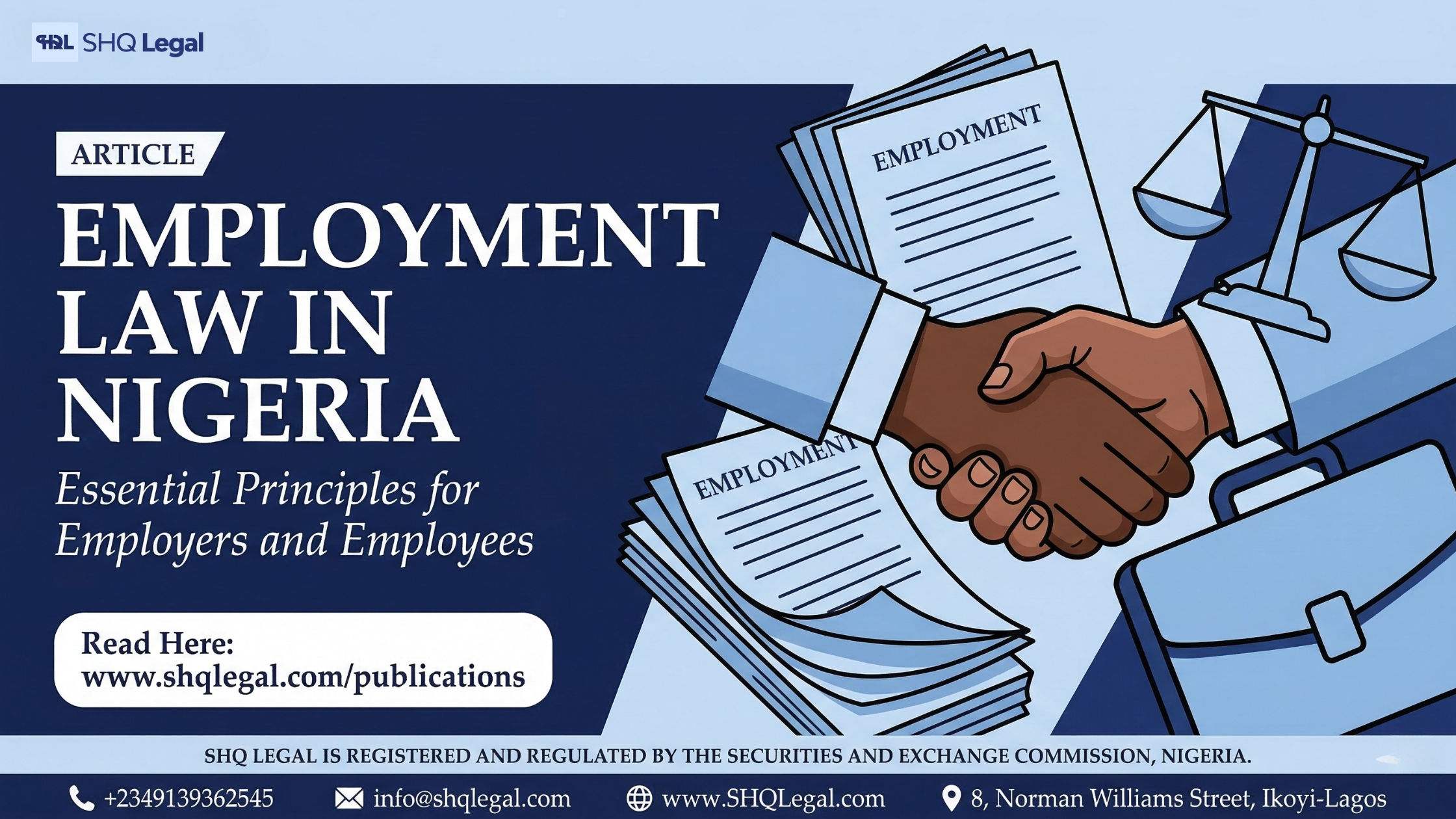
Employment relationships in Nigeria continue to evolve under the combined influence of statutory regulation, judicial interpretation, and international best practices. While the traditional common law doctrine of master and servant still underpins most private sector employment relationships, the National Industrial Court (“NICN”) has increasingly infused fairness, equity, and global labour standards into its decisions.
For employers, the risk landscape now extends beyond simple contractual compliance to include exposure to claims for wrongful termination, constructive dismissal, workplace harassment, and unenforceable post-employment restraints. For employees, understanding the limits of the employer’s powers particularly regarding variation of terms, disciplinary action, and resignation is equally critical. This thought piece distils the core principles emerging from Nigerian statutes and case law, with practical guidance for employers, employees, in-house counsel, lawyers, and law students.
The Contractual Foundation of Employment
At the heart of every employment relationship lies a contract. Under Nigerian law, the contract of employment remains the primary document governing the relationship between employer and employee. Section 7 of the Labour Act, 2004 requires employers to provide written particulars of employment within three months of engagement. However, the courts have consistently recognised that employment terms may also be contained in collateral documents such as staff handbooks, policy manuals, and collective agreements provided they are properly incorporated. The Court of Appeal in Akpabot v. College of Education, Uyo (1985) emphasised that for handbook provisions to be binding, the employer must demonstrate clear incorporation into the contract. Similarly, in Jubril Adetunji Oladapo v. Chevron Nigeria Limited (2005) 1 NWLR (Pt. 907), the court affirmed that employment rights and obligations may derive from multiple interconnected documents.
From a risk management perspective, employers must ensure that staff handbooks are expressly incorporated into the contract of employment, that employees formally acknowledge receipt of such policies, and that the organisation applies the policies consistently in practice. Failure in these areas frequently undermines disciplinary measures and termination decisions.
Variation of Employment Terms
A foundational principle of contract law is that parties are bound by the terms they freely negotiated. Accordingly, an employer generally cannot unilaterally vary the terms of employment without the employee’s consent. The orthodox legal position is that variation requires mutual agreement. Where an employer attempts a material unilateral change such as a salary reduction, demotion, or significant alteration of duties the employee may challenge the action as wrongful or rely on it to ground a claim for constructive dismissal.
An important qualification exists where the contract expressly reserves to the employer a unilateral right of variation. Nigerian courts, applying the doctrine of freedom of contract, will usually uphold such clauses if they are clearly and unambiguously drafted. Even in such circumstances, however, emerging NICN jurisprudence and best practice strongly favour prior notice, consultation, and the exercise of the power in a reasonable manner. The courts will typically distinguish between minor administrative adjustments and fundamental alterations that strike at the root of the contract. While minor operational changes may fall within managerial prerogative, changes affecting remuneration, status, or core responsibilities are more likely to attract judicial scrutiny. Employers must therefore exercise contractual variation clauses cautiously, ensuring that such powers are not applied arbitrarily or in bad faith.
From a governance perspective, employers should document consultations, obtain written acknowledgment of agreed variations, and clearly communicate the commercial rationale behind any proposed changes. Transparent engagement not only reduces litigation exposure but also strengthens organisational trust and workforce stability.
Working Hours and Employee Welfare
The Labour Act adopts a flexible approach to working hours. Section 13 provides that hours of work are to be fixed by agreement between the employer and the worker, whether individually or through collective bargaining. The statute deliberately avoids prescribing rigid daily limits. In practice, Nigerian courts and labour practitioners frequently look to international standards particularly the International Labour Organisation (ILO) Hours of Work Convention, 1919 as persuasive guidance. That Convention prescribes eight hours per day and forty-eight hours per week for industrial undertakings. The legality of working hours in Nigeria therefore depends heavily on context. Courts typically consider the nature of the employer’s business, the employee’s role and seniority, prevailing industry practice, and whether the workload imposed is oppressive or unsafe. Where working hours are excessive without adequate rest, especially in safety-sensitive sectors, employers may face exposure under occupational safety principles and the constitutional right to dignity of the human person.
Modern employee welfare obligations extend well beyond wages. Regulators and courts increasingly expect employers to maintain comprehensive workplace frameworks addressing health and safety, anti-harassment protections, ICT usage, anti-bribery compliance, and overall workplace wellbeing. Organisations that treat these as mere formalities rather than active governance tools face growing litigation risk.
Training Bonds: Enforceability and Limits
Training bonds remain a recognised labour practice under Nigeria law. Employers, particularly in specialised industries such as aviation, oil and gas, and financial services frequently sponsor professional trainings and require employees to commit to a minimum service period or refund the associated training costs upon early exit. Nigerian courts have consistently held that training bonds are enforceable provided they satisfy the test of reasonableness. In Attorney-General of the Federation v. Awojoodu (1973) 3 UILR 4, the court enforced a government scholarship bond even though the beneficiary attempted to avoid signing it, holding that the government was entitled to recover the public funds invested in the employee’s education. The NICN reaffirmed the enforceability of such arrangements in Overland Airways Limited v. Captain Raymond Jam (2015) 62 NLLR (Pt. 219) 525. The court rejected the pilot’s argument that the bond constituted an unlawful restraint of trade and instead upheld the employer’s right to recover training costs, prorated to reflect the unserved portion of the bonding period.
Similarly, in Allied Air v. Engineer Kwabena Sarfo Ossei (NICN/LA/464/2014, 6 April 2017), the court emphasised that training expenses represent legitimate business investments which employers are entitled to protect. From the judicial trend, a training bond is most likely to be upheld where the bonding period is reasonable (commonly between one and three years), the training provides demonstrable value to the employee, the repayment obligation is not punitive in nature, and the bond is executed before or at the time the training is undertaken. Bond periods that stretch excessively particularly beyond five years are unlikely to survive scrutiny.
To enhance enforceability, employers must therefore ensure that training bonds are clearly drafted, proportionate in duration, and carefully structured to reflect actual training costs. When reasonably implemented, such arrangements are not restraints of trade, but legitimate mechanisms for safeguarding corporate investment in human capital.
Termination of Employment Under Nigerian Law
- The Governing Framework
Termination of employment in Nigeria is shaped by the Labour Act, constitutional fair hearing principles, judicial precedent, and the express terms of the employment contract. Except in employments with statutory flavour, the traditional common law rule still largely applies: an employer may terminate for a good reason, bad reason, or no reason at all, provided the contractual procedure is strictly followed. The Supreme Court reaffirmed this position in Obanye v. Union Bank of Nigeria Plc (2018) LPELR-44702 (SC).
It is a well-established principle of Nigerian employment law that the employer’s motive for terminating an employment relationship is generally immaterial. The courts have repeatedly held that the presence of ill will, bad faith, or even malice does not, without more, invalidate a termination. What matters is objective compliance with the contract and any applicable statutory provisions. Thus, a termination will only be set aside where the employee proves that the employer breached the terms of the contract, violated an incorporated policy or handbook provision, or acted contrary to a statutory requirement such as those under the Labour Act. In the absence of such breach, courts applying the traditional common-law approach will not interrogate the fairness or propriety of the employer’s decision-making process.
However, recent jurisprudence of the NICN has shown an increasing willingness to interrogate the fairness of employer decisions. In Aloysius v. Diamond Bank Plc (2015) 58 NLLR (Pt. 199) 92, the court suggested that employers should provide justifiable reasons for termination, signalling a gradual shift toward substantive fairness review.
- Procedural Requirements for Lawful Termination
To minimise exposure to wrongful termination claims, employers must observe careful procedural discipline. The starting point is strict compliance with the notice provisions contained in the contract of employment or, where the contract is silent, the default notice periods prescribed by the Labour Act. Equally important is the timing of payment in lieu of notice. The Supreme Court in Chukwumah v. Shell Petroleum Development Company (1993) 4 NWLR (Pt. 289) 512 made it clear that where an employer elects to terminate with payment in lieu, the payment must accompany the termination letter. Deferred payment undermines the validity of the termination.
Where misconduct is alleged, the employee must be given a fair opportunity to respond. The courts apply the test articulated in Laws v. London Chronicle Ltd (1959) 2 All ER 285, which asks whether the employee’s conduct demonstrates an intention to disregard an essential condition of the contract. Failure to follow the employer’s own disciplinary procedure frequently renders a dismissal wrongful. Employees whose appointments are terminated remain entitled to all accrued benefits up to the effective date of termination, as confirmed in Udegbunam v. FCDA (2003) 10 NWLR (Pt. 829) 487. In the oil and gas sector, employers must additionally comply with the Department of Petroleum Resources Guidelines on Release of Staff. Failure to obtain ministerial approval where required may attract significant sanctions, as discussed in Raphael Obasogie v. Addax Petroleum (NICN/LA/257/2013).
Refusal of Resignation Under Nigerian Law: Why Employers Cannot Reject Resignations
A persistent misconception among employers is that an employee’s resignation requires acceptance before it becomes effective. Nigerian law firmly rejects this notion. The courts have repeatedly held that resignation is a unilateral right of the employee. In Yesufu v. Governor of Edo State (2001) 13 NWLR (Pt. 731) 517, the Supreme Court affirmed that once a resignation letter is communicated in accordance with the contract, the employment relationship is effectively terminated. This principle was reinforced in WAEC v. Oshionebo (2006) 12 NWLR (Pt. 994) 258, where the Court of Appeal held that an employer cannot reject a properly tendered resignation. The NICN went further in Jneh Monday Mgbeti v. Unity Bank Plc (NICN/LA/98/2014, 21 February 2017). The bank’s handbook purported to prohibit resignation while disciplinary proceedings were pending. The court struck down the provision as unconstitutional and tantamount to forced labour, emphasising that an employee retains the freedom to withdraw his services at any time.
The practical implication is that while employers may continue investigations, recovery actions, or even report suspected misconduct to law enforcement after resignation, they cannot lawfully compel an employee to remain in service.
Constructive Dismissal: When Resignation Becomes Termination
Nigerian law recognises the doctrine of constructive dismissal, although the jurisprudence is still developing. Constructive dismissal arises where the employer’s conduct fundamentally undermines the employment relationship and leaves the employee with no real option but to resign. The leading Nigerian authority is Miss Ebere Ukoji v. Standard Alliance Life Assurance Co. Ltd (2014) 47 NLLR (Pt. 154) 531. In that case, the employee resigned following sustained hostile treatment and disciplinary pressure. The NICN held that although she formally resigned, the resignation was not truly voluntary because the employer’s behaviour had made continued employment intolerable. The court explained that constructive dismissal occurs where the employer creates working conditions so difficult that the employee has little or no practical choice but to leave.
To succeed in such claims, the employee must demonstrate a fundamental breach by the employer, show that the breach rendered continued employment intolerable, and establish that the resignation followed promptly after the offending conduct. Delay may be interpreted as waiver or condonation, as noted in Joseph Okafor v. Nigerian Aviation Handling Company Plc (NICN/LA/291/2016). Employers should therefore exercise caution when implementing unilateral demotions, drastic salary cuts, hostile investigative tactics, or workplace humiliation, as these may inadvertently ground constructive dismissal claims.
Effect of Business Reorganisation on Employment Contracts
Corporate restructuring whether through merger, acquisition, outsourcing, or liquidation—frequently raises complex employment consequences. Under Section 10 of the Labour Act, a contract of employment cannot be transferred from one employer to another without the employee’s consent. This reflects the deeply personal nature of employment relationships. In asset acquisition scenarios, although the purchasing entity may assume certain employment liabilities, employees must still consent to the transfer of their contracts. Where consent is not obtained, employees may treat the original contract as terminated and pursue their entitlements accordingly.
The position is more definitive in insolvency situations. Where a company enters compulsory liquidation, the law treats the event as analogous to the death of the employer. Consequently, employment contracts terminate automatically. The liquidator is then required to settle outstanding employee claims, some of which enjoy preferential status under the Companies and Allied Matters Act. Employees affected by insolvency may lodge proofs of debt in the winding-up proceedings, although claims for damages arising from wrongful dismissal do not typically enjoy priority ranking. For acquirers and investors, thorough employment due diligence and carefully structured employee transfer arrangements are essential to avoid unexpected liabilities.
Sexual Harassment and Employer Liability
Workplace sexual harassment has emerged as one of the most significant sources of employment litigation in Nigeria. The concept broadly encompasses unwelcome sexual advances, physical contact, sexually coloured remarks, and any conduct that creates a hostile or degrading work environment. Nigerian courts increasingly impose vicarious liability on employers who fail to respond adequately to complaints. The landmark decision in Ejieke Maduka v. Microsoft Nigeria Ltd illustrates the modern judicial approach. The claimant alleged persistent harassment by the Country Manager and reported the conduct internally without meaningful intervention. Her employment was subsequently terminated.
The NICN relied heavily on international instruments, including the Convention on the Elimination of All Forms of Discrimination Against Women (CEDAW) and ILO Convention No. 111, and held that the harassment violated her constitutional right to dignity. Crucially, the court found both Microsoft Nigeria and its parent company vicariously liable because their inaction amounted to tolerance and ratification of the misconduct. The decision underscores the judiciary’s expectation that employers must maintain effective anti-harassment policies, provide accessible reporting channels, and investigate complaints promptly and objectively. Organisations that fail to act decisively risk significant reputational and financial exposure even where senior management was not directly involved in the offending conduct.
The Future of Employment Law in Nigeria
Nigerian employment law is steadily transitioning toward a more balanced regime that preserves contractual freedom while imposing heightened standards of fairness, transparency, and workplace dignity. Employers who continue to rely solely on traditional “hire and fire” assumptions do so at increasing risk. Modern best practice demands carefully drafted contracts, properly incorporated policies, procedurally fair termination processes, reasonable training bond structures, and robust workplace conduct frameworks. For employees and practitioners, the expanding body of NICN jurisprudence offers growing protection against arbitrary treatment, forced retention, hostile work environments, and disguised dismissals. In the years ahead, organisations best positioned to avoid disputes will be those that treat employment law not merely as a compliance obligation but as a central pillar of corporate governance.
Disclaimer:
This article is provided for general informational purposes only and does not constitute legal, employment/labour, or professional advice. The contents reflect a summary and analysis of the of key statutory provisions, case law, and emerging jurisprudence governing employment relationships in Nigeria and should not be relied upon as a substitute for specific professional guidance. For further clarification or advice on how these developments may affect your organization, the Employment/Labour Practice Group of SHQ Legal is available to provide tailored legal and compliance support. You may direct any questions to info@shqlegal.com